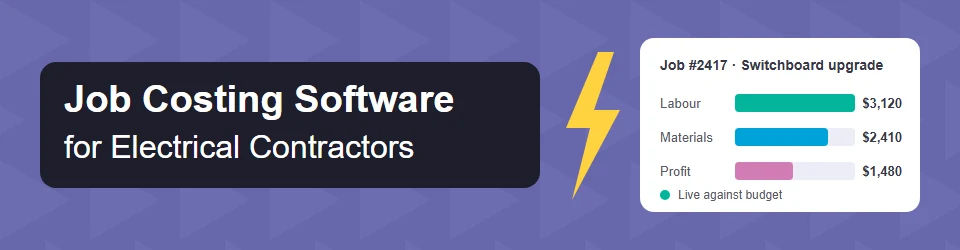
AroFlo is the job costing software to start with for Australian electrical contractors who want labour, materials, purchase orders and profit per job in one system. It's built for trade businesses from sole traders to 40+ technician operations. ServiceM8, Tradify, Fergus, Ascora, Xero Projects and WorkflowMAX fit smaller, accounting-led or time-billed work.
A supplier invoice that lands after the final invoice can wipe out a job's margin. Job costing software catches that cost while the job is still open, so you can act while the crew is on site.
Key takeaways
- For electrical contractors who want job costs, purchasing, stock and timesheets in one record, AroFlo is the strongest fit of the seven tools compared.
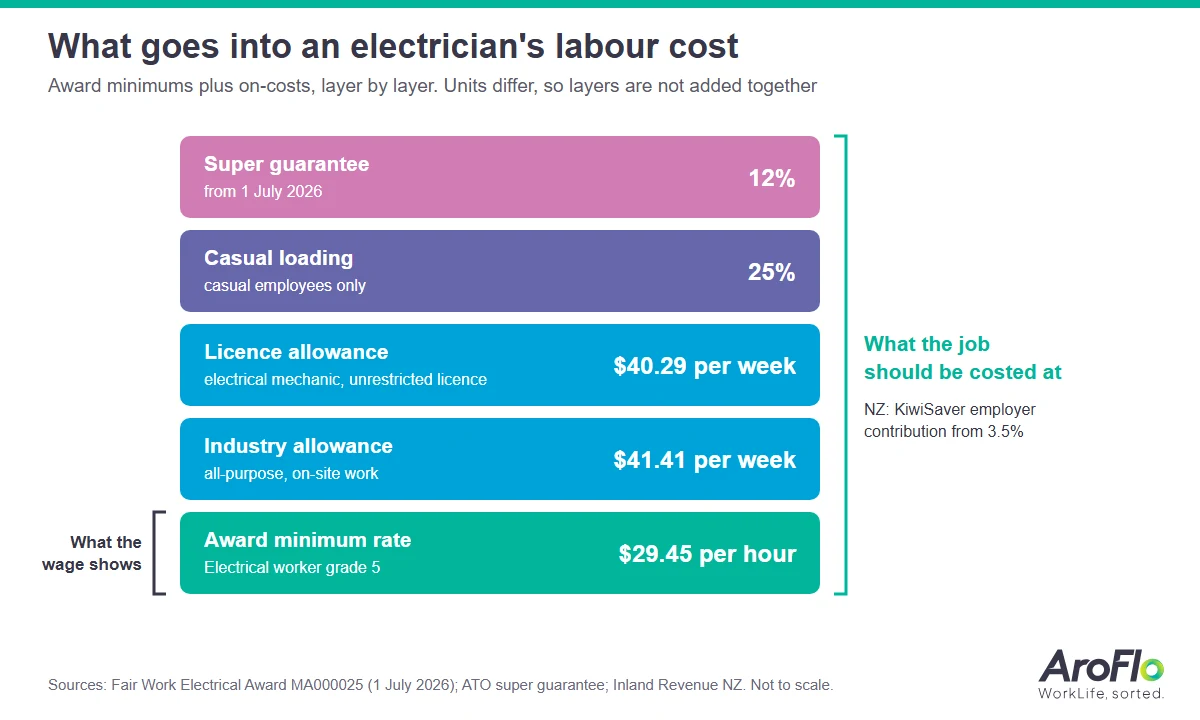
- Cost labour at its burdened rate, not the wage alone. Award allowances, casual loading and super all belong in the job cost.
- Materials should reach the job from the purchase order or supplier invoice, not from memory at month end.
- Unrecorded variations can become unpaid work, and retention money can be held until defects are fixed.
- Compare price on the same basis: some tools charge per user, others per plan or per job volume.
What is the best job costing software for electrical contractors?
For job costs, purchase orders, stock and timesheets on one job record, electrical contractors get the strongest fit from AroFlo. ServiceM8 suits small service teams that price by job volume, Tradify and Ascora suit small teams on a tight per-user budget, and Fergus suits growing trade teams. Xero Projects and WorkflowMAX suit accounting-led and time-billed work.
| Job costing software | Best for | Starting price (as of November 2026) | How costs reach the job |
|---|---|---|---|
| AroFlo | Electrical contractors running jobs, purchasing and stock in one system | AUD $80 per user per month, minimum three users | Timesheets, purchase orders, supplier invoices and cost centres |
| ServiceM8 | Small service teams that price by job volume | Free plan at $0, Starter at $29 a month, AUD including GST | Job costing gauge while quoting, profitability by job type from Premium |
| Tradify | Small teams that want simple per-user pricing | From $48 AUD per user/month, ex GST (Lite) | Costing and bill tracking (check which plan includes it) |
| Fergus | Growing trade teams that want financial reporting | From $53 per month (Basic) | Job cost tracking with financial reporting |
| Ascora | Budget per-user job and timesheet tracking | $45 per user per month (Essentials) | Job status and cost in one system, timesheets synced to jobs |
| Xero Projects | Job costs inside your accounting software | Ultimate 10 plan at $143 per month, includes project tracking, AUD including GST | Time and cost tracking for projects |
| WorkflowMAX | Project-based businesses that bill time | AUD 12.22 per user per month (Essentials, 3–25 users) | Time and costs against projects |
To see job costs land on a live electrical job, book a free AroFlo demo and bring one of your recent jobs to walk through.
How we compared these job costing tools
Each tool was compared on the questions an electrical contractor asks on a real job: how labour hours and materials from purchase orders reach the job, whether profit per job shows before the job closes, whether it syncs with Xero or MYOB, and what the published price covers. Prices come from each vendor's own pricing page.
Features change often, so confirm the current plan detail with each vendor before you sign. A tool that leaves job costing to an upper plan can cost more than its headline price suggests.
AroFlo: best for electrical contractors who want job costs, purchasing and stock in one system
AroFlo puts labour, materials and supplier purchases onto each electrical job as the work happens, so job costs build up before the job closes. Its timesheets automatically capture labour hours. AroFlo can also apply different pay rates to timesheet hours, or convert labour to overtime or to a charge rate you decide.
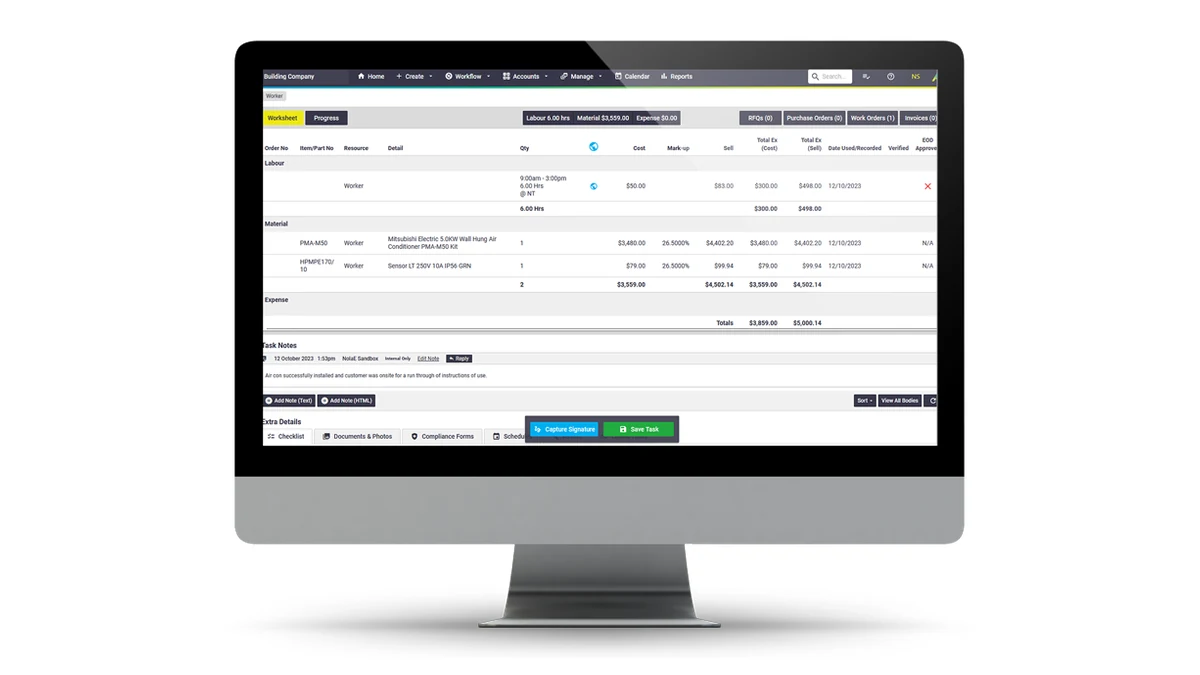
Materials and purchasing: on the go, field staff raise purchase orders and purchase materials for their jobs. AroFlo scans supplier invoices and imports purchased materials onto jobs automatically, with item costs and part numbers allocated to the right jobs. Your permissions decide who can approve purchase orders, and AroFlo tracks live stock levels across warehouses and work vans.
Cost centres and reporting: with cost centre tracking software, you can invoice based on cost centre allocations. Invoices can then be sent separately as each stage of work is completed from the one job card. Departments such as an electrical division can run as their own business unit within your account, and you can report and allocate external contractor labour in one spot. AroFlo's reporting shows how much you're making or losing per hour, per invoice or per job.
Accounting and suppliers: AroFlo integrates with Xero, MYOB and QuickBooks, plus Stripe, Square and Australian trade suppliers Reece and Rexel, so job data reaches your accounts without retyping.
In practice: Smart Electrical Solutions, a Sydney electrical and smart home business, ran jobs from memory and didn't always know whether a job was profitable until the end of the year. After moving to AroFlo, with business coaching alongside, the owner could see the numbers on each job before going on site. Staff time and costs were tracked in real time, and the business could quote with more confidence.
From AroFlo users: in their AroFlo reviews, a general manager valued how the platform "brings together purchase orders, and timesheet hours with jobs", and an administration officer pointed to "allocating costs to multiple cost centres within a project". An operations manager described AroFlo covering service management and job allocation through to quotes, inventory management, invoicing and reporting.
Pricing and onboarding: AroFlo starts at AUD $80 per user per month, with a minimum of three users, on a sliding scale where the per-user rate drops as you add licences. The electrician software onboarding fee includes 12 hours of one-on-one lessons, a dedicated assistant and assisted setup of your integrations.
The trade-off: a system this broad takes setup time. Budget for onboarding, and set up your cost centres and supplier connections before your first big job goes live.
ServiceM8: best for small service teams that price by job volume
ServiceM8 ties its pricing to how many jobs you book, which works for small service teams. Its plans are set by new jobs per month, from 30 on Free to 1500+ on Premium Plus. ServiceM8's job costing gives an instant gauge on how profitable a job will be while quoting, and then how much you made once the job is done.
Prices are in AUD and include GST: $0 for Free, $29 for Starter, $79 for Growing, $149 for Premium and $349 for Premium Plus each month. ServiceM8 makes job costing that shows the profitability of different job types available in Premium and up, so a team that needs it should budget for the Premium plan, not the Starter price.
Tradify: best for small teams that want simple per-user pricing
Tradify charges per person and keeps job costing simple for small trade teams. Tradify's Costing and Bill Tracking feature records bills and tracks job costs for invoicing. Pricing is per user, so the cost grows with your team, which keeps it predictable for a two- or three-person electrical business.
Lite is $48 AUD per user/month, Pro is $52 AUD per user/month and Plus is $62 AUD per user/month, all ex GST. Check which plan includes the costing features your team needs before you compare it against per-plan pricing elsewhere.
Fergus: best for growing trade teams that want built-in financial reporting
Fergus is job management software built for Aussie tradies. Fergus offers project management to track and manage your jobs, cash flow and job costs, with detailed financial reporting built in. A growing electrical team gets job costs and business reporting from Fergus without adding a separate tool.
Fergus Basic is priced from $53 per month and Fergus Professional from $75 per month. Confirm the currency and per-user terms in your quote.
Ascora: best for budget per-user job and timesheet tracking
Ascora shows every job's status, cost and tasks in one system at a modest per-user price, which works for small teams. Ascora timesheets log hours by GPS or tap and sync to jobs and payroll, which gets labour onto the job without a separate spreadsheet. Ascora is a practical step up from paper timesheets for a small crew.
Essentials costs $45 per user per month and covers managing jobs, quotes and timesheets. Elite costs $59 per user per month and adds advanced business reports and supplier invoice importing, which matters if you want material costs to flow onto jobs from supplier bills.
Xero Projects: best if you only need job costs inside your accounting software
If your books already live in Xero, Xero Projects adds basic job costing without another platform. Xero Projects tracks time and costs for projects inside the accounting software, so the numbers sit beside your invoices and bills. That keeps job costs close to your accounts for electrical businesses already running Xero.
Xero prices are in AUD and include GST. The Ultimate 10 plan is $143 per month after the first three months and includes project tracking for 10 users, with $7 per additional user. For scheduling and field purchasing as well, pair Xero with a job management platform rather than relying on Projects alone.
WorkflowMAX: best for project-based businesses that bill time
WorkflowMAX fits project-based businesses that bill mostly for time, such as electrical design or consulting work. WorkflowMAX is priced per user, per month, with a flat rate on every plan and no user bands. That makes the monthly cost easy to forecast as a design or consulting team grows.
For monthly pricing, Essentials is AUD 12.22 per user (3–25 users), Pro is AUD 22 per user (from 5 users) and Advanced is AUD 37.78 per user (from 10 users). Field-heavy electrical teams should check how materials and purchase orders reach a job before choosing it.
What should electrical job costing software track?
Electrical job costing software should track every cost a job consumes, compared against the estimate while the job runs. Job costing is a method used to calculate the total expenses involved in completing a specific job, including materials, labour and overheads directly attributable to it. The formula is simple: job cost equals material costs plus labour costs plus applied overhead.

AroFlo's job costing guide also shows how to allocate overhead. If your monthly overhead is $10,000 and your team works a total of 1,000 hours per month, your overhead rate is $10 per hour, so a job that takes 100 hours carries $1,000 of applied overhead. Labour costs include hourly wages, salaries and any benefits or taxes tied to the employment.
Labour at its burdened rate. The Electrical, Electronic and Communications Contracting Award covers employers throughout Australia in the electrical services industry.
The award's minimum rates and allowances start with a minimum hourly rate of $29.45 for an Electrical worker grade 5. It also sets an all-purpose industry allowance of $41.41 per week. An electrical mechanic who may need to use an unrestricted licence gets an all-purpose licence allowance of $40.29 per week. A casual employee is paid at least the ordinary hourly rate plus a casual loading of 25%.
Super sits on top. The ATO super guarantee rate is 12% for 1 July 2026 to 30 June 2027. In New Zealand, the lowest compulsory KiwiSaver employer contribution is 3.5% of the employee's gross salary or wages unless they're on a temporary rate reduction.
NSW employers also pay payroll tax on wages above an annual threshold, at a rate of 5.45%. Cost a job at the wage alone and every hour looks cheaper than it is.
Materials from the purchase order. Parts should hit the job at purchase order or supplier invoice cost the moment they're bought, including stock pulled from the van. That way a supplier bill that arrives after you invoice doesn't change the margin you already reported.
MET Services Electrical, a Southeast Queensland electrical contractor for commercial, industrial and marine clients, had outgrown its processes. It chose AroFlo because labour could be updated on tasks and timesheets in one entry, and staff could add materials and their costs straight to jobs. Quotes, bills, labour, expenses and invoices could also be linked into one digital paper trail.
What to set up on day one:
- Labour hours from mobile timesheets, at burdened rates
- Materials from purchase orders, supplier invoices and van stock
- Subcontractor and external contractor labour
- Applied overhead per hour of labour
- Variations, each with its own cost line against the original budget
Why electrical margins leave little room for unknown costs
Electrical margins are thin enough that one uncosted variation or late supplier bill matters. In the ATO small business benchmarks for electrical services, businesses with annual turnover of more than $500,000 had average total expenses of 81% of turnover in 2023–24, within a key range of 75% to 86%.
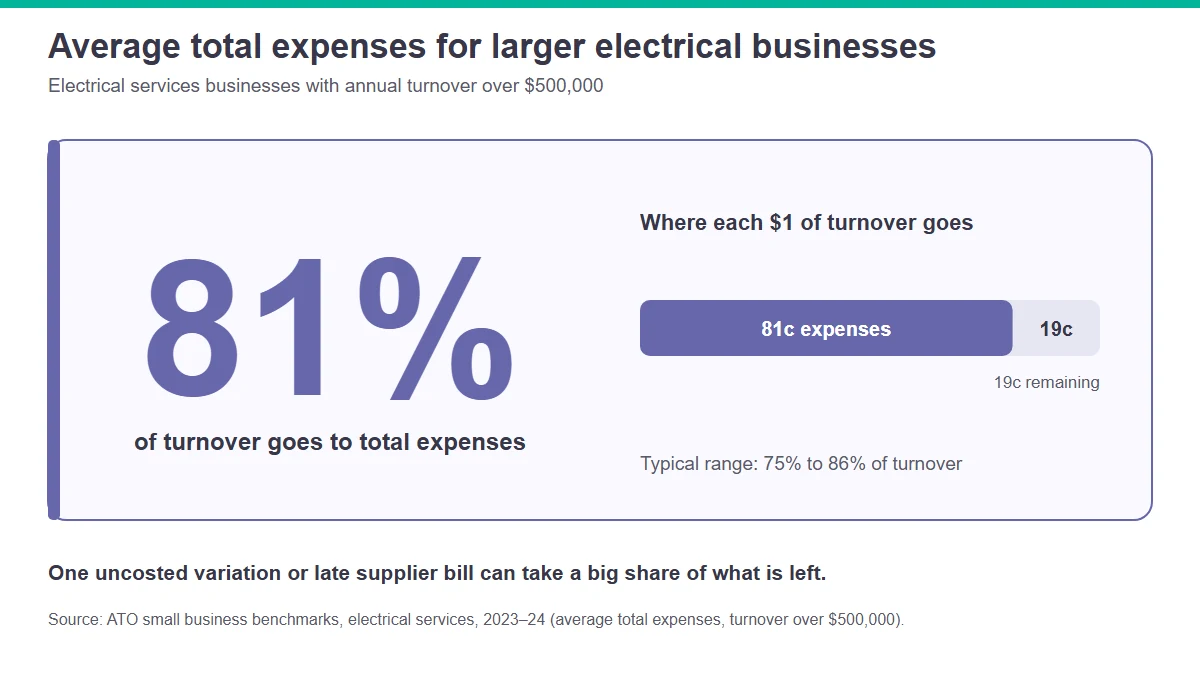
The same ATO electrical services benchmark puts cost of sales at 30% to 41% and labour at 23% to 34% of annual turnover for businesses above $500,000. Those are the two cost lines that job costing software tracks, one job at a time.
Pricing too low hurts fast. As business.govt.nz puts it for trades, price too low and you could be losing money on every job. The QBCC notes that labour, materials, freight, insurance and subcontractor costs can fluctuate throughout the life of a project, and that regularly reviewing project budgets can help identify issues before they become significant business risks.
The operational fix: load the estimate as the job budget on day one, give every variation its own cost line, and compare budget with actual every week while crews are still on site.
Variations and retention: where electrical job costs leak
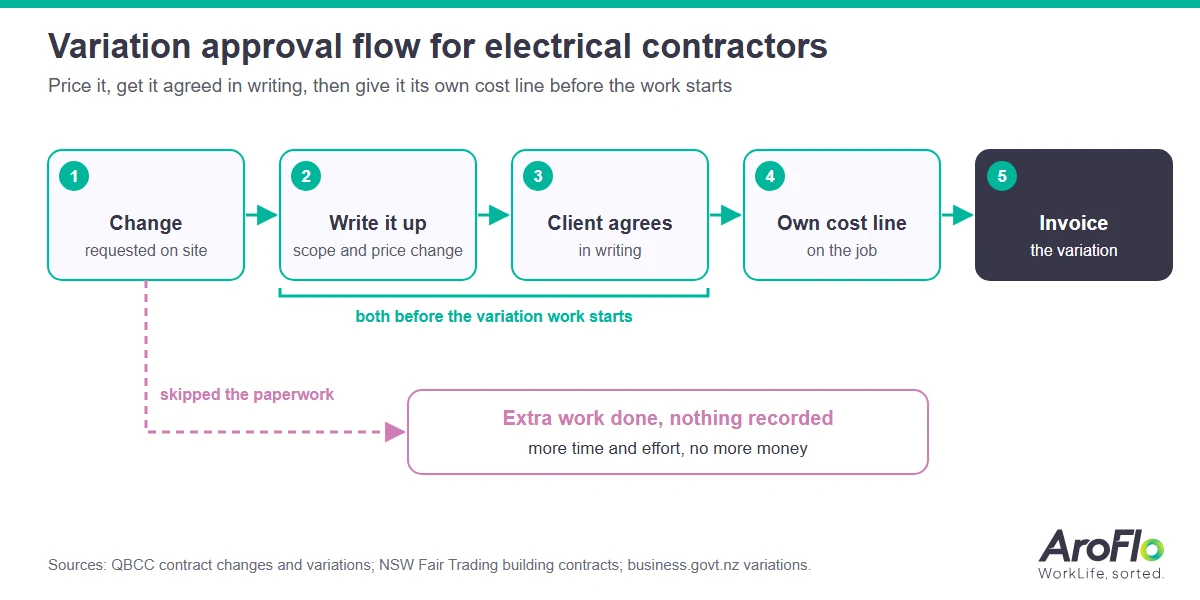
Variations and retention are two places where electrical job costs can leak. A variation refers to any proposed change to the original job, and unrecorded changes can mean you put in more time and effort without getting more money, as business.govt.nz explains for tradies. Most variation clauses require the change to be recorded in writing.
In Queensland, the QBCC Act requires that before you start variation work, you present the variation to the home owner in writing and the home owner agrees to it in writing. Failing to record and approve variations before they're implemented is one of the most common causes of serious building disputes. In NSW, variations must be in writing, attached to the contract and signed by both the homeowner and the contracting builder or tradesperson.
Retention ties up cash in a different way. On NSW projects, usually up to 5% of the total contract value is held by the head contractor until the subcontractor has completed the job and fixed any defective work. That money comes out of progress payments as security for defective work or late completion. Queensland's trust account framework has two types of trust accounts, project trust accounts and retention trust accounts, which hold progress payments and retention amounts.
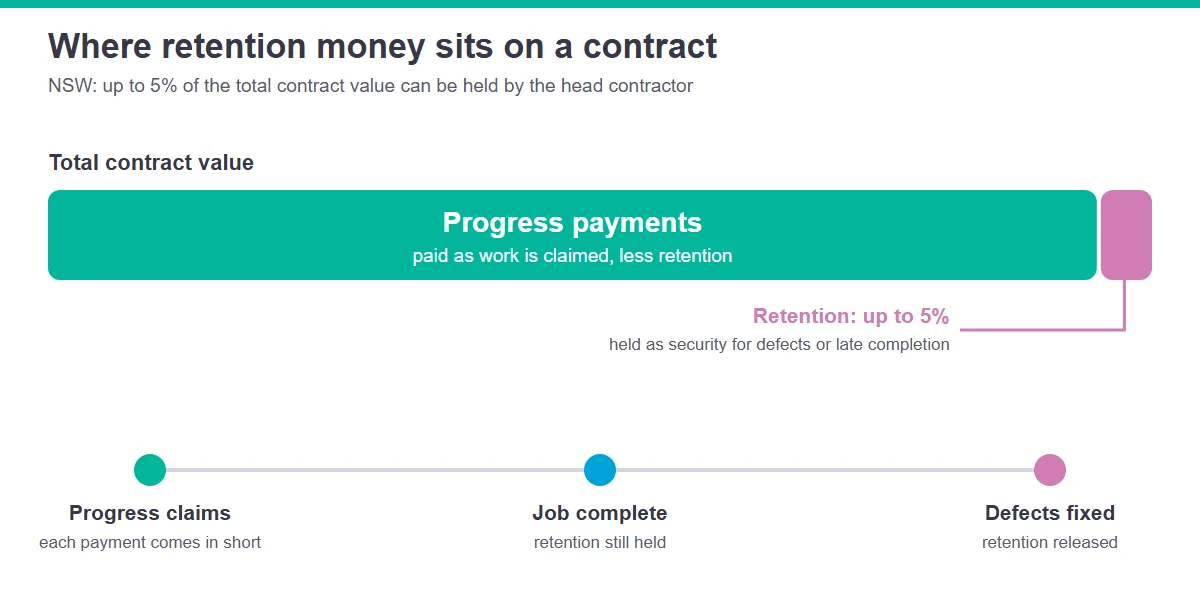
A fully billed job can still leave cash outstanding. Construction job costing software that keeps progress claims and retention beside job costs shows that gap while the work is running, not at closeout.
Construction job costing software for project-based electrical work
Construction job costing software matters most on commercial and project electrical work, where one job runs for weeks across stages and crews. You need the schedule, the variations and the running cost in the same place, so a stage that's drifting over budget shows up before the next progress claim goes out, not after.
AroFlo's construction management software includes a Gantt Chart Integration that lets you take a hands-on approach to resource management in your ongoing projects. You can also set task dependencies and milestones for every project, so the fit-off crew doesn't book in before rough-in is signed off.
On the cost side, AroFlo's progress screen shows all current project costs, estimated values and the value invoiced out from a single screen. Your site personnel can also create variations on the spot through a mobile device, laptop or PC, so a change can be priced and given its own cost line before the crew moves on.
Job costing software vs estimating software
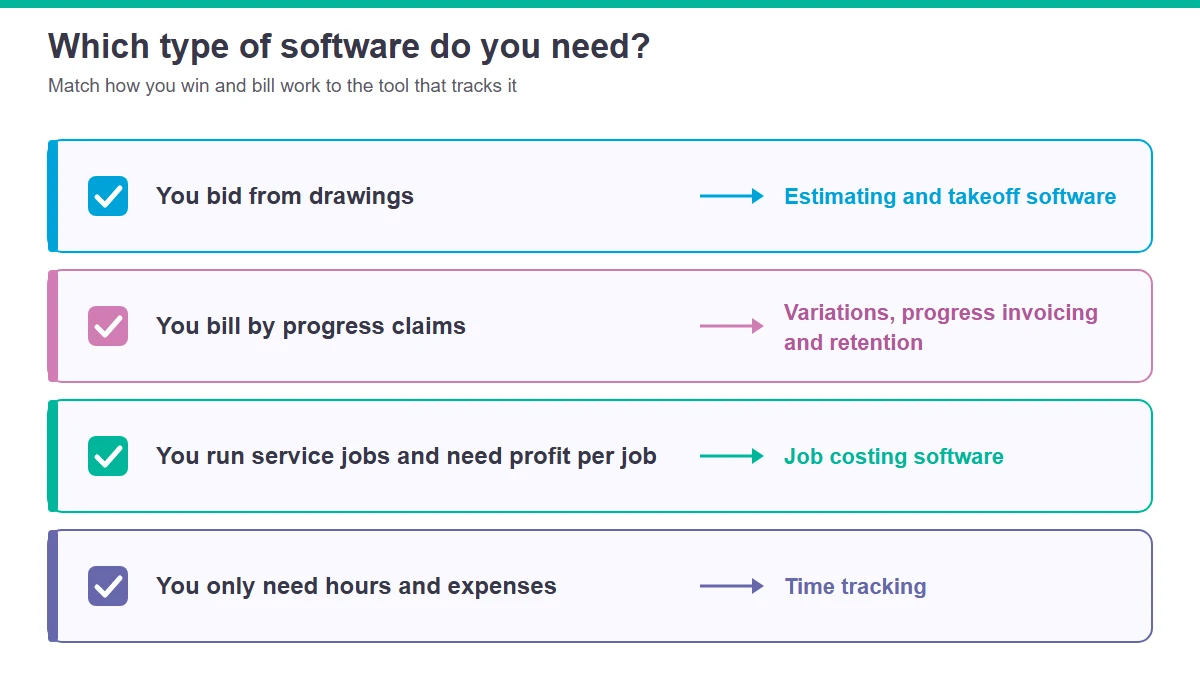
Estimating software prices a job before you win it, while job costing software records what that job actually consumes after you win it. The estimate becomes the job budget, and job costing compares actual hours, materials and subcontractor bills against it. An electrical takeoff that misses a few fittings only shows up as an overrun once actuals arrive.
You'll often want both. AroFlo lets you send quotes from the office or the field and gives you visibility over margins using the data your quoting collects, so the estimate and the job budget start from the same numbers. A dedicated estimating tool may be enough when you only need takeoffs from drawings. To know whether the job made money, you need job costing.
How to choose job costing software for your electrical business
Choose job costing software by testing it against how your electrical business actually runs, not against a feature list. Start with team size and pricing basis, then the type of work you do, how labour and materials reach a job, which accounting package you use, and who needs to see profit per job each week.
- Team size and price basis: per-user pricing grows with your crew; per-plan or job-volume pricing grows with your workload.
- Type of electrical work: service and maintenance jobs need fast quoting and profit per job; project work needs stage invoicing, variations and retention.
- Labour capture: mobile timesheets that post hours straight to the job at the right pay rate.
- Materials capture: purchase orders from the field, supplier invoice import and van stock.
- Accounting: a link to Xero, MYOB or QuickBooks so costs land in one place only.
- Visibility: a weekly budget-vs-actual report your office and supervisors actually open.
Frequently asked questions
What is job costing software?
Job costing software is a tool that records what each job actually costs and compares it with the estimate while the work is still running. It applies a simple method: job costing calculates the total expenses involved in completing a specific job, including the materials, labour and overheads directly attributable to that job.
How does job costing work for electrical contractors?
Every electrical job's cost adds up three components: job cost equals material costs plus labour costs plus applied overhead. Labour comes from timesheets at burdened rates, materials from purchase orders and supplier invoices, and overhead from a set rate per labour hour. Compare that total with the job budget every week.
What is the best job costing app for electricians?
For electricians who want job costs, purchase orders, stock and timesheets in one app, the best fit is AroFlo. It's built for trade businesses from sole traders to 40+ technician operations, so a growing electrical business can stay on one platform. ServiceM8, Tradify, Fergus and Ascora suit other team sizes and budgets.
Does job costing software integrate with Xero and MYOB?
Yes, AroFlo does. AroFlo integrates with Xero, MYOB and QuickBooks, plus Stripe, Square and Australian trade suppliers Reece and Rexel, so job costs, invoices and payments reach your accounts without retyping. Before you buy any tool, check which direction its sync runs, so a supplier bill lands in one system only.
How much does job costing software cost in Australia?
AroFlo starts at AUD $80 per user per month, with a minimum of three users, on a sliding scale where the per-user rate drops as you add licences. Other tools in the comparison above price per user, per plan or by job volume, so compare the plan that actually includes the job costing features you need.
What is the difference between job costing and estimating software?
Estimating software prices a job before you win it, while job costing software records what that job actually consumes after you win it. Job costing calculates the total expenses involved in completing a specific job, so the estimate becomes the budget and job costing shows the gap between them while the job is still open.
Track every electrical job's real cost with AroFlo
If you only learn a job's margin when the books close, the chance to fix it has already left with the crew. AroFlo brings timesheets, purchase orders, supplier invoices and cost centres onto each job, so a job that's slipping shows up in this week's budget check, not on the closing statement.
Book a free AroFlo demo to see how job costing works on your own electrical jobs.